




Accessible Overview. Confident Navigation.
Braille Tactile Maps are a best-practice wayfinding tool that provide a Tactile overview of an environment, supporting people to understand a space before moving through it. They play an important role in creating environments that are safer, more inclusive, and easier to navigate, particularly for people who are blind or have low vision.
By combining Tactile features, clear Braille, and high-contrast and textural surfaces, these maps deliver accessible, hands-on information that supports spatial understanding, strengthens confidence, and promotes independent navigation.
While not a mandatory requirement under the NCC, Australian Standards provide clear guidance for their design and application, recognising the value they bring to accessible and inclusive environments.
Raised Braille & Tactile Maps may include key building and site information such as paths of travel, entrances, vertical circulation, and essential facilities, supporting users to orient themselves and navigate with greater independence.


Why Braille Tactile Maps Matter
Braille Tactile Maps support:
• Spatial Understanding and Orientation
• Independent Navigation
• Confidence Within a Space
• Connection to the Tactile Path of Travel
They complement existing signage and wayfinding systems, strengthening the overall accessibility of an environment.

Designed for Clarity and Compliance
Our maps are developed in accordance with AS 1428.4.2:2018 and are designed to be clear, legible, and easy to interpret.
Key features include:
• Simplified Layouts for Easy Understanding
• Clear Braille and Tactile Elements
• High-Contrast and Textural Surfaces
• Logical Hierarchy of Information
Suitable for indoor and outdoor environments, including public buildings, campuses, transport hubs, and complex facilities.

Permanent and Temporary Applications
Braille Tactile Maps can be designed for both permanent spaces and temporary events.
In permanent environments, they provide a reliable, long-term wayfinding reference at key arrival and decision points.
For events, they offer clear, event-specific navigation, supporting participation, comfort, and inclusion.

Scalable and Project-Ready
Our approach supports both one-off installations and large-scale projects.
• Consistent Outcomes Across Multiple Areas and Locations
• Repeat Production with Controlled Variations
• Quality and Accuracy Maintained at Scale
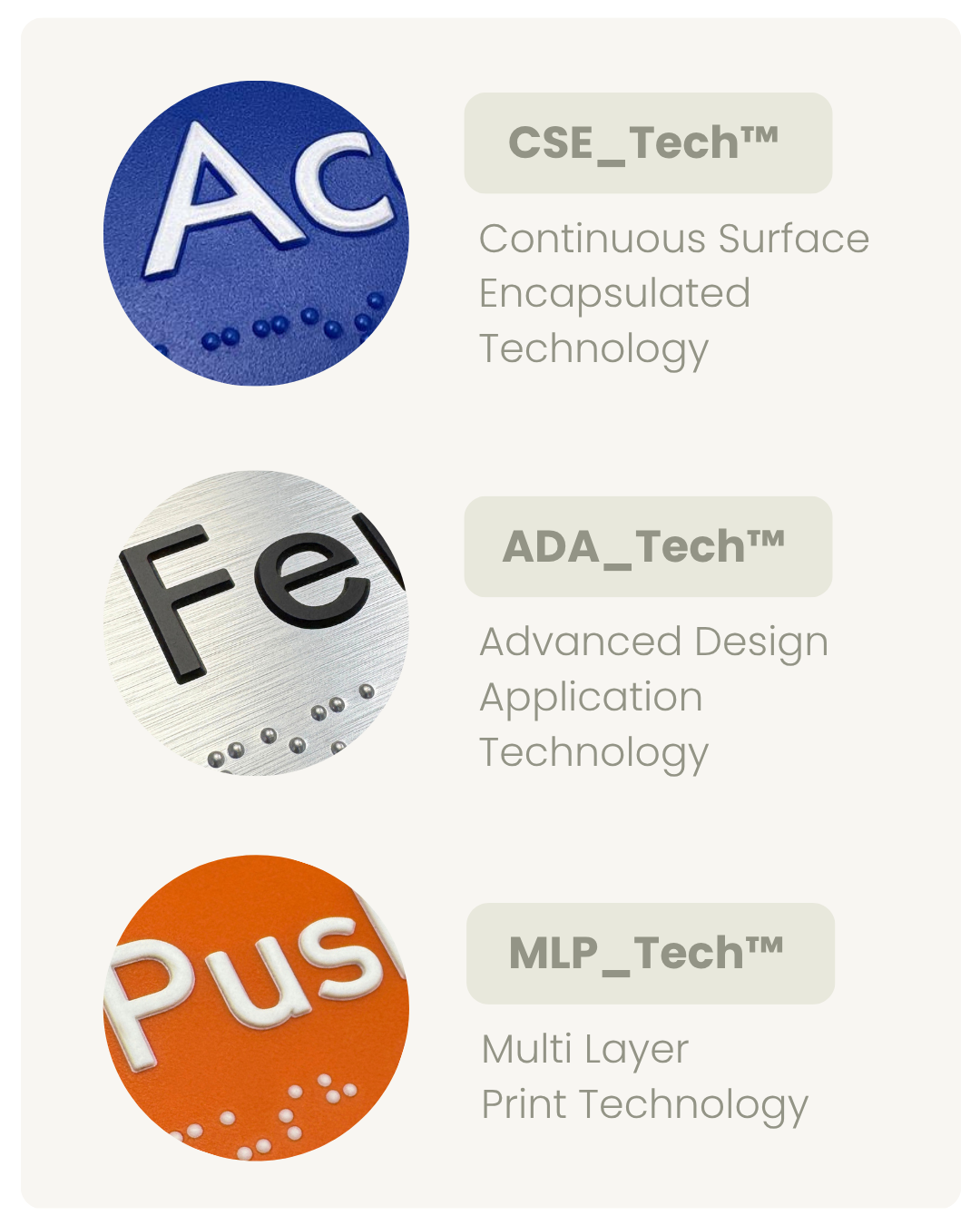
Technology Flexibility That Sets Us Apart
Braille Tactile Signs Aust. is unique in offering 3 (three) distinct signage technologies, which can be used individually or combined within a single map.
• CSE_Tech™ Continuous Surface Encapsulated Technology
• ADA_Tech™ Advanced Design Application Technology
• MLP_Tech™ Multi Layer Print Technology
Why This Matters
This creates a level of flexibility that is not typically available within a single supplier, allowing designers and project teams to achieve a more considered and refined outcome.
It supports:
• Alignment with Design Intent
• Greater Creative Flexibility
• Cost-Efficient Solutions
• Suitability for Environment and Application
• The Right Balance of Detail, Durability, and Performance
Applied Outcomes
• CSE_Tech™ Supports Durable, and Repeatable Map Production, Ideal for High-Traffic Environments and Large-Scale Rollout Programs
• ADA_Tech™ Allows for Variation in Finishes and Architectural Integration
• MLP_Tech™ Enables Finer Detail, Textures, and More Complex Visual Elements
This ability to combine technologies creates a wide range of tailored outcomes, giving designers greater control while ensuring each solution performs as required.
Braille Tactile Map Project Gallery
Explore a range of Braille Tactile Maps across different environments, applications, and project scales.


Design and Production Support
We work closely with architects, designers, consultants, and project teams to guide both design and production.
• Design Development and Layout Guidance
• Material and Technology Selection
• Prototype and Sample Development
• Coordination Through to Production

Architects

Builders

Signage

Transport

Government

Healthcare

Education

Recreation

Accomodation

Retail

Corporate

Community


